
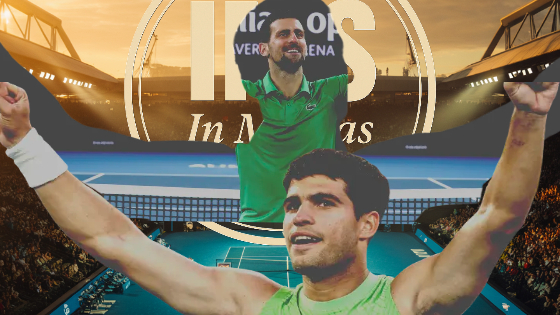
The first Grand Slam tournament of the year flowed like a slow little stream from always exciting and often humid Melbourne, instantly transporting tennis fans into the summer tennis vibe, especially those who, in the middle of winter, are sitting somewhere in Europe or North America.
There were no particularly huge thrills or gigantic clashes that so often emerge already in the first few rounds, but there were still touching moments — I’m thinking, for example, of the farewells of Monfils or Wawrinka. And then we arrived at the men’s semifinals, which, I must say, compensated everyone who might have felt a slight sense of lack until then.
I would start by saying that, since this article is a kind of personal account and a subjective evaluation, despite the fact that Novak Djokovic reached the semifinals of all four Grand Slams last year, I would not have thought even in my dreams that he would be capable of such a performance, especially after seeing the first and second sets against Musetti, where, as he himself put it, he was already on his way home.
Of course, I was not alone in this: many experts believed that over the course of a long, physically completely exhausting, body-draining Grand Slam tournament he would no longer be able to reach the level of Sinner and Alcaraz, and that very unusual circumstances would be needed for him to defeat even one of them.
So what are these circumstances, or perhaps we should rather call them conditions?
First of all, it is important that he should, as much as possible, not play five- or six-hour matches before the semifinals. He should try to win his matches as quickly as possible, in three, at most four sets, and not spend five hours on court already in the second round, because every extra movement, every additional load gradually erodes his chances.
The next point, and this also shows how intelligent and conscious an athlete Djokovic is, is that a strong service game is key. Of course, one could say that the service game is always key, but what Djokovic showed was impressive, especially on break points and in crucial moments in the semifinal against Sinner. In terms of both precision and the willingness to take risks on second serves, he knows that without this it simply does not work; he clearly understands that below a certain level of aggressiveness he has no chance. He has to shorten rallies and play tennis in a more risky, aggressive way.
Musetti’s unfortunate injury, and his advancement without having to play against Mensik before that, laid the groundwork for him to be at such a physical level that he was capable of enduring many hours of physical strain.
There was a moment in his semifinal against Sinner when it felt as if he had run out of energy, but with Djokovic we have seen many times throughout his career that, based on his body language, he looks as if he is about to faint, and then, suddenly, from somewhere out of nowhere, from his heart or perhaps from the power of the crowd (because that was also very much needed), he comes back to life again, like a video game character when his life bar is fully recharged.
This Rate the Game is not about the semifinal now, but one thing is certain: I was wrong, just as many others were, because Novak Djokovic is not the kind of athlete you can write off, and anyone who does so is definitely making a mistake.
His knowledge, experience and genius, both tactically and in terms of pure ability, make him a huge legend. As I watched him during the ceremony after the final, as he spoke, it was especially moving the way he addressed Rafa Nadal sitting in the stands. And it occurred to me that his sporting achievement goes beyond tennis, and that he should be mentioned not only among the greatest figures in tennis, but among the greatest names in the entire history of sport.
It cannot be known — as he himself emphasized — what will happen three months from now or nine months from now, and we cannot know whether he will achieve his 25th Grand Slam title. I still believe that many circumstances and conditions, that many stars, have to align for this to happen, but one thing is certain: I will never underestimate him again, not even ten years from now 🙂
But let us not forget the winner of the 2026 Australian Open, Carlos Alcaraz, about whom it is becoming increasingly difficult to find words. After his victory, he wrote on the camera “job finished”: at the age of 22, he completed the career Grand Slam, and with this he became the youngest player in the history of the men’s game to achieve a career Grand Slam. Federer was 27, Nadal 24, Djokovic 29 when they accomplished it, just to mention the Big Three.
What is impressive about Alcaraz is how multifaceted his game is, how much variation he is capable of, how he can enrich his game with volleys and drop shots. For me, while Sinner represents stability, Alcaraz is finesse itself.
In addition, what must be highlighted is that at the age of 22 he has a mental strength that, in my opinion, even the greatest players did not have at that age. In critical moments, when the opponent has a set point or match point, he does not focus on how much he must win this point, on how he must not make a mistake; instead, he looks at how much pressure there might be on his opponent. He builds brilliantly from situations in which he knows that his opponent is also under mental pressure.
A few words about the match:
Djokovic won the first set with brilliant play, but somehow you could feel that this level, this aggressive tennis, could not be maintained over three sets. As Djokovic visibly struggled more and more with exhaustion, Alcaraz’s game kept improving steadily.
Somewhere in the fourth set, Djokovic received a small adrenaline boost (also using the crowd for this), and it seemed that he might return to the disciplined, precise and ruthless tennis of the first set, but Alcaraz no longer allowed him back into the match.
If we strip it down to pure tennis, in my opinion the final itself was not as big a match as, for example, the 2025 Roland Garros final, but whatever happened in this final was inevitably a historic event, it set the basic tone: the match, the ceremony, everything together felt as if the past, the present and the future had embraced each other on the tennis court in a hug spanning generations.
If I had to rate this event on a scale from 0 to 100, I would give it 82 points.
82
Write to me how you saw it, how many points you would give it, and I also look forward to articles on Rate the Game and other topics. Tell us what match you watched — any sport is welcome — share your opinions and analyses, and within the framework of Rate the Game let us rate the events from a fan’s perspective.