At an American football game, there’s a split second when everyone in the stadium senses trouble. The running back has already crossed the line of scrimmage, his blockers trailing behind, the defense converging from poor angles. The commentator’s voice rises, fantasy owners nod in anticipation, and then, like a badly timed jump cut, the ball suddenly pops free from the frame.
It’s not a bone-rattling hit or a heroic tackle. It’s a deliberate, surgically precise punch thrown straight at the football. Chaos. Shouts. Fumble. Turnover. And when the replay rolls in slow motion, the line that has become almost reflexive over the past decade inevitably follows:
“Classic Peanut Punch.”
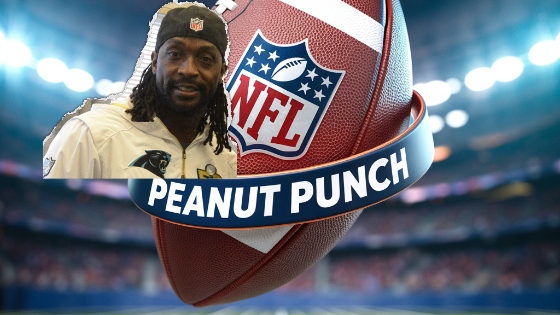
The move, now firmly embedded in the NFL lexicon, was born from the obsession of a lanky, long-armed cornerback. Charles Tillman—known to everyone simply as “Peanut”, was never the fastest or the most physically imposing defender in the league. But he was driven by a singular conviction: every ball carrier, no matter how secure he seemed, was vulnerable. Somewhere, somehow, the football could be dislodged.
The “Peanut Punch” didn’t just define Tillman’s career; it subtly reshaped defensive philosophy across the NFL. Tackling, in his hands, became more than a means of stopping forward progress. It became an opportunity. an intentional, calculated attempt not merely to end a play, but to steal possession and tilt the game in a single, violent flick of the fist.
Background: A Nickname and an Obsession
Tillman’s nickname dates back to the day he was born. He was so small that his aunt thought he looked like a peanut, he arrived weighing just five pounds.
“I was just five pounds at birth, really small, and my Aunt Renee remarked, ‘Oh, he looks like a little peanut,'” Tillman shared with BBC Sport. “It stuck with me, and even at 44 years old, my family rarely calls me Charles.”
He would eventually grow into a 6-foot-2, physical cornerback, but the name never left him. At the University of Louisiana at Lafayette, where he played his college football, coaches drilled an idea into him early: don’t just attack the man, attack the football.
At Copperas Cove High School, it was defensive coordinator Rodney Southern who first drew Tillman’s attention to the advantage of his long arms.
“Use your reach. Go for the ball when you tackle,” Southern told him.
Later, even as Tillman moved on to college, Southern kept reinforcing the same idea: if he was already piling up more tackles than most defensive backs, he could be forcing far more turnovers—”could have forced a lot of balls out if you could just punch it.”
Tillman would later admit that, at some point, he became obsessed with fumbles. He didn’t mind if his angle wasn’t textbook, as long as he could get to the football from behind or from the side. In fact, he often chose those imperfect angles on purpose. Approaching ball carriers from the rear or from the flank gave him the best chance not just to bring them down, but to rip the ball free.
The method found its true significance in the NFL. The Chicago Bears selected Tillman in the second round of the 2003 Draft, 35th overall, and the prototype of the move surfaced in his very first game.
Running downfield on punt coverage as a gunner, he spotted the returner, Jimmy Williams, carrying the ball loosely—”like a loaf of bread,” as Tillman later described it. He took a swipe. The ball came out. Patrick Mannelly recovered it.
“That’s when I said, ‘Oh yeah, I can do this in this league, too,'” Tillman recalled. “And I just started punching them out.”
Early on, he had wondered whether the technique would survive the NFL’s speed and physicality. That moment erased the doubt.
From then on, the cornerback understood: this would work at the highest level. Over the next decade, the Bears’ defense built its identity around takeaways, and at the heart of it was Tillman’s philosophy, every tackle contains the possibility of the football.
How the Peanut Punch Works
At a glance, the Peanut Punch can look like a wild swing. In reality, it’s anything but. It is controlled, deliberate, and repeatable.
The setup. Tillman always secured the situation first. He narrowed the space, squared his shoulders, and positioned himself so that if the ball didn’t come loose, the tackle would still be made.
The target. He wasn’t attacking an arm or a shoulder. He aimed for the football’s most vulnerable point, the exposed back tip, especially when a ball carrier held it loosely in the classic “loaf of bread” position, tucked casually along the side.
The punch. The motion was short and straight, almost like a boxer’s jab, not a looping swing. The force came from a compact, controlled strike. The key was a quick snap of the wrist and palm, often directed precisely at the seam of the ball.
The insurance. One hand punched; the other closed. If the ball stayed put, the tackle was still secured. Tillman never gambled recklessly, discipline was built into the technique.
That’s the difference between a reckless strip attempt and the Peanut Punch: discipline. It wasn’t blind risk-taking. It was a conscious, repeatable skill. Tillman produced such consistent results because he never sacrificed the sure tackle for the spectacular takeaway.
Throwback to the "The Peanut Punch Game" 👀pic.twitter.com/KRR4OSGrfA
— Football’s Greatest Moments (@FBGreatMoments) January 25, 2026
By the Numbers
Over the course of his career:
- 13 NFL seasons (Chicago Bears 2003–2014; Carolina Panthers 2015)
- 168 games played (164 starts)
- 44 forced fumbles (sixth-most in NFL history)
- 38 interceptions for 675 yards (8 returned for touchdowns)
- 930 tackles (790 solo)
- 3 sacks—just three, a number that underscores the point: he wasn’t forcing fumbles as a pass rusher
- In 2012, Tillman recorded 10 forced fumbles—an extraordinary total for a defensive back, and still a benchmark season at the position. That same year, he was named First-Team All-Pro by the Associated Press and earned his second Pro Bowl selection.
- In 2013, he received the Walter Payton NFL Man of the Year Award, recognizing not only his on-field excellence but also his work in the community.
His most unforgettable performance came on November 4, 2012, against the Tennessee Titans, when he forced four fumbles in a single game, an NFL record in the modern statistical era (tracked officially since 1991). The Bears won 51–20, and for one afternoon, Tillman single-handedly dismantled Tennessee’s offense. “I’ll never forget that game,” one Bears fan later said. “It was one of the most dominant performances I’ve ever seen, and one player caused four forced fumbles in a single game.”
The context makes the 44 forced fumbles even more remarkable. Historically, the leaders in that category are pass rushers, defensive ends and linebackers who generate sacks and jar the ball loose from quarterbacks. The top names on forced fumble lists typically come with 70-plus career sacks.
Tillman finished with three.
Nearly every one of his forced fumbles came from true ball carriers—running backs and receivers who had already secured possession. Among defensive backs, very few appear near the top 25 all-time: Charles Woodson (33 forced fumbles, 20 sacks) and Brian Dawkins (32 forced fumbles, 26 sacks). All are Hall of Fame–level players or widely viewed as such—and all recorded significantly more sacks.
Tillman’s 44 forced fumbles combined with 38 interceptions amount to 82 direct takeaways. In his career, the turnover wasn’t an exception. It was a weapon.
We don’t care about any class now or in the future unless it has Charles "Peanut" Tillman.
— CAPTAIN CEEBEE 🏴☠️🐻⬇️ (@Bears_Hype_Man) December 30, 2025
Ever heard of the Peanut Punch? https://t.co/FtTmCbnkap pic.twitter.com/u9XcoijNjP
The Legacy of the Peanut Punch
For years, the Peanut Punch felt like a Chicago specialty. Gradually, it became part of the league’s shared vocabulary. As analytics gained influence, particularly the emphasis on turnover differential, the philosophy behind the move only grew stronger. One extra takeaway over the course of a season can swing games. Sometimes, it can swing seasons.
A recent example came in 2024, when the Philadelphia Eagles led the league in forced fumbles—many of them rooted in Peanut Punch principles. Ahead of Super Bowl LIX, head coach Nick Sirianni told BBC Sport: “Our video guy got me every Peanut Punch that he forced a fumble with, and we kept watching them.”
The Eagles used the technique twice in the NFC Championship Game against Washington, a performance that helped propel them to the Super Bowl and ultimately to a title.
Today, multiple teams practice ball disruption systematically. Coaches incorporate hand-speed drills that emphasize attacking the football, not just the man. What began as an individual quirk has become a teachable skill. The Peanut Punch is now a concept—one every young defender learns, whether he lines up at linebacker, safety, or corner.
Significance
The Peanut Punch isn’t a new physical act; it’s a shift in emphasis. Defense is no longer just about stopping forward progress—it’s about reclaiming possession.
Tillman didn’t overwhelm opponents with brute force. He targeted. A controlled, precise strike and suddenly the offense was scrambling to recover. In 2022, the National Football League formally recognized the Peanut Punch as an established football concept, a rare distinction for a technique born from one player’s personal obsession.
Tillman has said he’s not even sure where the term “Peanut Punch” originated, joking later that he should have trademarked it. But the name no longer belongs to him alone. It belongs to the league, a shared language, perhaps the highest compliment he could have received.
The next time a running back seems headed for a routine first down and the ball suddenly skitters across the turf, pause the replay. That’s not just a turnover. It’s a philosophy at work.
It’s the legacy of a five-pound newborn who grew into a defensive back and quietly changed the way defenders think about the football, the tackle, and the art of taking the ball away.
“Peanut Punch.”